Project A03

Project A03

Personalised support for task-based diagnosing and intervening in mathematics and physics based on eye movements and log data

Summary

How do pre-service teachers learn to diagnose and respond to student thinking? In Project A03, we investigate this question in mathematics education. Pre-service teachers work in a digital simulation environment where they analyse virtual students’ work and choose suitable learning tasks. Using eye-tracking and log data, three experimental studies examine how diagnostic and instructional competencies develop and how they can be effectively supported. Based on these findings, the project uses eye-tracking and log data to personalise micro-adaptive support that helps future teachers make informed instructional decisions.


Participants

Principal Investigators

Research associates

Collaboration partners

Goal

Project A03 investigates how pre-service mathematics teachers develop competencies for diagnosing and responding to student thinking. The project identifies the knowledge and skills underlying effective diagnostic and instructional decision-making and explores how personalised support can be designed to foster these competencies systematically.

Research Questions

  • Which diagnosing and intervening process profiles can be identified among pre-service teachers in a simulation using eye-tracking and log data?

  • How can diagnosing and intervening process profiles be classified in real time using machine-learning algorithms based on eye-tracking and log data?

  • How are diagnosing and intervening process profiles related to pre-service teachers’ prior knowledge and the outcomes of diagnosis and intervention?

  • What effects do adaptive scaffolds have on the processes of diagnosing and intervening?

  • What differences exist between different types of PCK scaffolds with regard to diagnostic competencies?

  • Do personalised PCK scaffolds influence diagnostic competencies?

Methodology

In this project, pre-service mathematics teachers work in a digital simulation environment based on authentic classroom cases. They analyse students’ solutions to tasks on linear functions, diagnose students’ understanding, and select appropriate learning tasks. Eye-tracking and log data are used to capture these diagnostic and intervention processes. A between-subjects design examines the effects of a PCK intervention on both processes and outcomes. Machine-learning algorithms classify process profiles in real time and use these classifications to provide personalised support through adaptive prompts. The analyses combine quantitative and qualitative approaches, including analyses of variance, correlation analyses, sequence analyses, and clustering methods.

Role Within the Collaborative Research Center

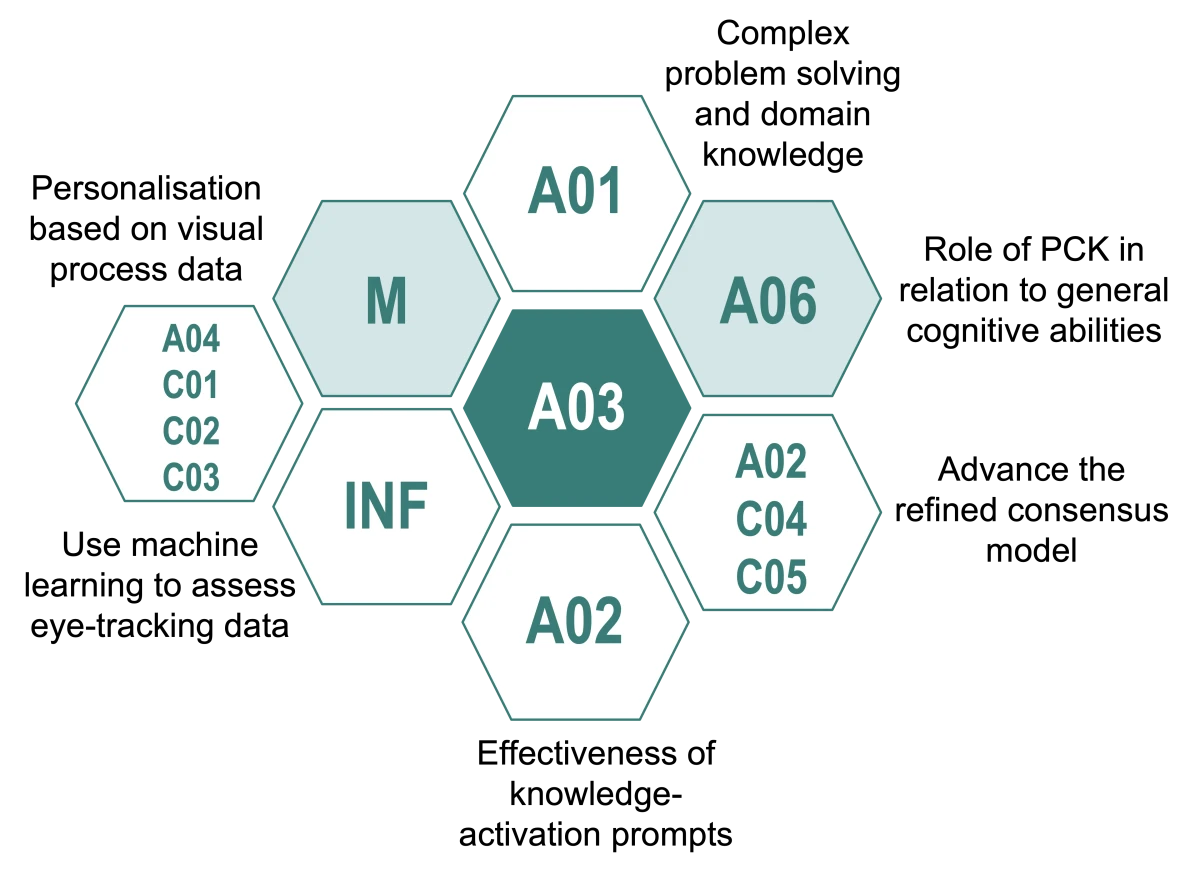
  • A01, A03, A06: Investigating complex problem-solving and its interaction with domain knowledge.

  • A03, A06: Examining the role of pedagogical content knowledge (PCK) in relation to general cognitive abilities.

  • A02, C04, C05: Substantiating the RCM and investigating how learners transform personal PCK (pPCK) into enacted PCK (ePCK) in simulation-based learning environments.

  • A02, C02: Joint conceptualisation of diagnostic and intervention competencies in mathematics and physics and investigation of the effectiveness of knowledge-activation prompts.

  • C01–C03, A04, A06 (guided by INF): Applying machine-learning methods in eye-tracking research.

  • A01, B01: Developing and providing simulation environments for B06.

  • A02, A04, A05, B01, B02, C01–C05: Advancing theory on cue salience and informational complexity for representational scaffolding.

  • A04, A05, C01–C03, Project M: Developing approaches to personalisation based on visual process data.

  • Project M: Joint collection, provision, and aggregation of process data.

  • Project INF: Research data management and the personalisation of simulation environments.

Publications

2024

2023

2021

2020

2019