Project C02

Project C02

Professional vision in diagnosing visual problem-solving strategies for graphs in physics and medicine

Summary

C02 examines how gaze data can be used to recognise difficulties in graph comprehension. It focuses on how personalised support can facilitate professional vision and the acquisition of diagnostic knowledge and skills. The project investigates this in two domains: medical education and physics teacher education. It first analyses learners’ difficulties during graph comprehension to develop targeted scaffoldings based on learners’ gaze data. These scaffoldings are implemented in an adaptive simulation to support the diagnostic skills of pre-service physics teachers and final-year medical students.


Participants

Principal Investigators

Research associates

Collaboration partners

Goal

C02 examines how gaze data can be used to recognise difficulties in graph comprehension. It focuses on the question of how personalised scaffolding can support professional vision and the acquisition of diagnostic knowledge and skills. The project investigates this in two domains: medical education and physics teacher education. It first analyses learners’ difficulties during graph comprehension to develop scaffoldings based on learners’ gaze data. The project examines both representational and learning-process scaffoldings. These scaffoldings are implemented in an adaptive simulation to support the diagnostic skills of pre-service physics teachers and final-year medical students. In this context, C02 will also investigate the possible influence of learner characteristics.

Research Questions

  • Which gaze metrics capture differences in gaze behaviour between learners in medicine and physics (education) with and without difficulties during graph comprehension?

  • What are the effects of representational and learning-process scaffolding in simulations facilitating diagnostic skills of graph comprehension difficulties?

  • How do pre-service teachers’ and medical students’ learning processes capture their expertise while diagnosing learners’ discipline-specific and interdisciplinary graph comprehension skills?

  • Can personalised scaffolding facilitate pre-service teachers’ and medical students’ diagnostic skills?

  • How can personalised scaffolding facilitate pre-service teachers’ and medical students’ diagnostic skills?

Methodology

The project uses simulation-based learning environments in medical and physics teacher education, in which learners work on diagnostic tasks and receive different types of scaffolding. Methodologically, the project combines experimental designs with pre-, process-, and post-measurements to examine the diagnostic knowledge and skills, cognitive, metacognitive, and motivational-affective processes amongst others via questionnaires, knowledge tests, gaze and log data as well as think-aloud questions along other instruments. The analyses combine quantitative and qualitative approaches, including analyses of variance, correlations, and machine-learning methods. 

Role Within the Collaborative Research Center

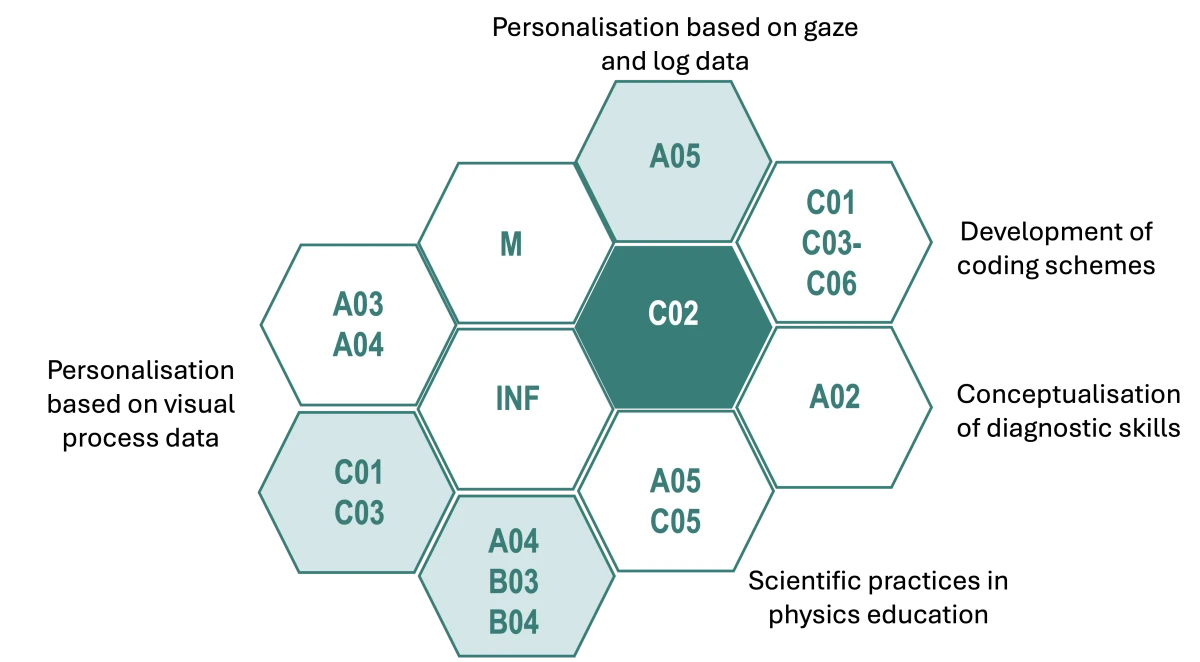
  • Joint data collection with Project M

  • Development of an automated process analysis with Project INF

  • A05: Personalisation based on gaze and log data

  • C01, C03-C06: Development of coding schemes

  • A02: Conceptualisation of diagnostic skills

  • A05, C05: Scientific practices in physics education

  • A03, A04 & C01, C03: Personalisation based on visual process data

  • A04, B03, B04: Think-aloud procedure

Publications

2023

2021

2020

2014