Project M

Project M

Project M focuses on joint measures, meta-analysis of evidence, and overarching theory-building.

Summary

M links the subprojects of SHARP through joint data collection and analysis. The goal is to consolidate findings across projects and use them to further develop overarching theoretical approaches. To this end, M coordinates the collection of common measures on learning prerequisites, learning processes, and learning outcomes. In addition, the project develops methods to evaluate the process data generated during the learning simulations across all projects. Furthermore, M consolidates the results both within and outside the Collaborative Research Centre (CRC) and uses them to develop a more comprehensive understanding of learning and learning processes.


Participants

Principal Investigators

Research associates

Collaboration partners

Goal

The aim of project M is to systematically integrate research findings from other SHARP subprojects, make them comparable, and further develop them theoretically. To achieve this, the project develops joint measurement instruments and methodologies for process data analysis while synthesizing evidence from SHARP and international research through meta-analytic approaches. Based on this work, Project M seeks to advance an overarching theoretical model of personalised simulation-based learning in higher education.

Research Questions

  • Under which conditions are personalised instructional supports effective in simulation-based learning environments?

  • To what extent are findings generalizable across domains, simulations, and learning contexts?

  • How can process data from heterogeneous simulations be aggregated in comparable ways?

  • Which latent learning and diagnostic processes can be derived from behavioral and process data?

  • What role do learner prerequisites play in personalised support?

  • How do scaffolding and feedback influence diagnostic and intervention-related skills?

  • What role do social interaction and collaboration play in simulation-based learning processes?

  • How can theoretical models of personalised learning be further developed across different domains?

Methodology

Project M is developing a methodology for joint data collection across all SHARP projects and common procedures for process data analysis. To this end, standardized questionnaires are used, and log, process, and learning-related behavioral data are standardized and aggregated. This is complemented by meta-analyses, systematic literature reviews, and transparent, formalized methods of theory development. The data will be analyzed using statistical modeling, MetaSEM, and machine learning methods to further develop theoretical models of simulation-based, personalised learning.

Role Within the Collaborative Research Center

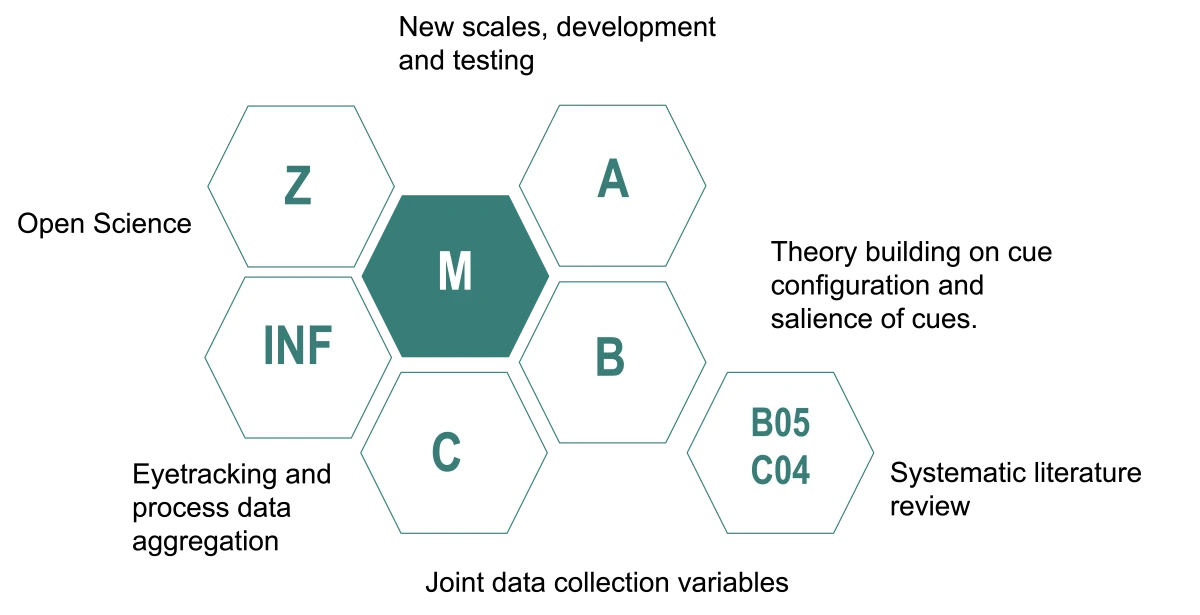
  • Collection of standardized joint variables across all projects

  • Summary analysis of process data across all projects

  • Cross-project theory development across all projects

  • Coordination of the Open Science working group with Z

  • Joint theory development on salience and the configuration of cues with A02–A05, B01, B02, C01–C05

  • Exchange on systematic literature reviews with B05 and C04

  • Use of eye-tracking data for personalisation with INF, A03, A04, C01, C02, C03.

Publications

2024

2023

2022

2021

2020

2017