Project B03

Project B03

Transforming errors into learning opportunities: Effects of personalised feedback after errors in simulations for mathematics and medical education

Summary

Project B03 examines how errors in simulations can become opportunities for learning. It focuses on the question of how personalised feedback after errors can support learning processes as well as the acquisition of diagnostic knowledge and skills. The project investigates this in two domains, medical education and mathematics teacher education. It considers both learners' own errors and so called advocative errors, meaning errors made by others that can also serve as a basis for learning. The project analyses how learner characteristics such as prior knowledge, tolerance for errors, and feedback tolerance relate to responses to errors, and how adaptive support in simulations can be designed on this basis.


Participants

Principal Investigators

Research associates

Collaboration partners

Goal

Project B03 examines how errors in simulations can become opportunities for learning. It focuses on the question of how personalised feedback after errors can support learning processes as well as the acquisition of diagnostic knowledge and skills. The project investigates this in medical education and mathematics teacher education. It considers both learners' own errors and advocative errors. The project analyses how learner characteristics relate to responses to errors, and how adaptive support in simulations can be designed on this basis.

Research Questions

  • How do learners with varying learning prerequisites benefit from different responses following errors in acquiring diagnostic knowledge and skills?

  • How are the responses after errors related to cognitive, metacognitive, and motivational processes?

  • Are the responses after advocative errors and one's own errors different?

  • Is the relationship of advocative errors and own errors to cognitive, metacognitive, motivational, and social processes different?

  • How does personalising feedback affect the acquisition of diagnostic knowledge and skills?

  • How do a macro- and micro-level strategy of personalising feedback affect cognitive and metacognitive learning processes?

  • How do a macro- and micro-level strategies of personalising feedback affect the acquisition of diagnostic knowledge and skills?

  • Can models for describing error-related processing, measures of corresponding support, and their effects be approached similarly in medical and mathematics education?

Methodology

The project uses simulation-based learning environments in medical and mathematics teacher education, in which learners work on diagnostic tasks and receive different forms of feedback after errors. Methodologically, the project combines experimental designs with pre, process, and post measurements to examine the effects of learners’ own errors, observed errors, and different personalisation strategies. Data include diagnostic knowledge and skills, learner prerequisites, responses to errors, and cognitive, metacognitive, and motivational-affective processes, assessed through questionnaires, knowledge tests, log data, behavioural sequences, and think-aloud or microanalytic questions. The analyses combine quantitative and qualitative approaches, including analyses of variance, correlations, sequence analyses, and learner profile modelling. 

Role Within the Collaborative Research Center

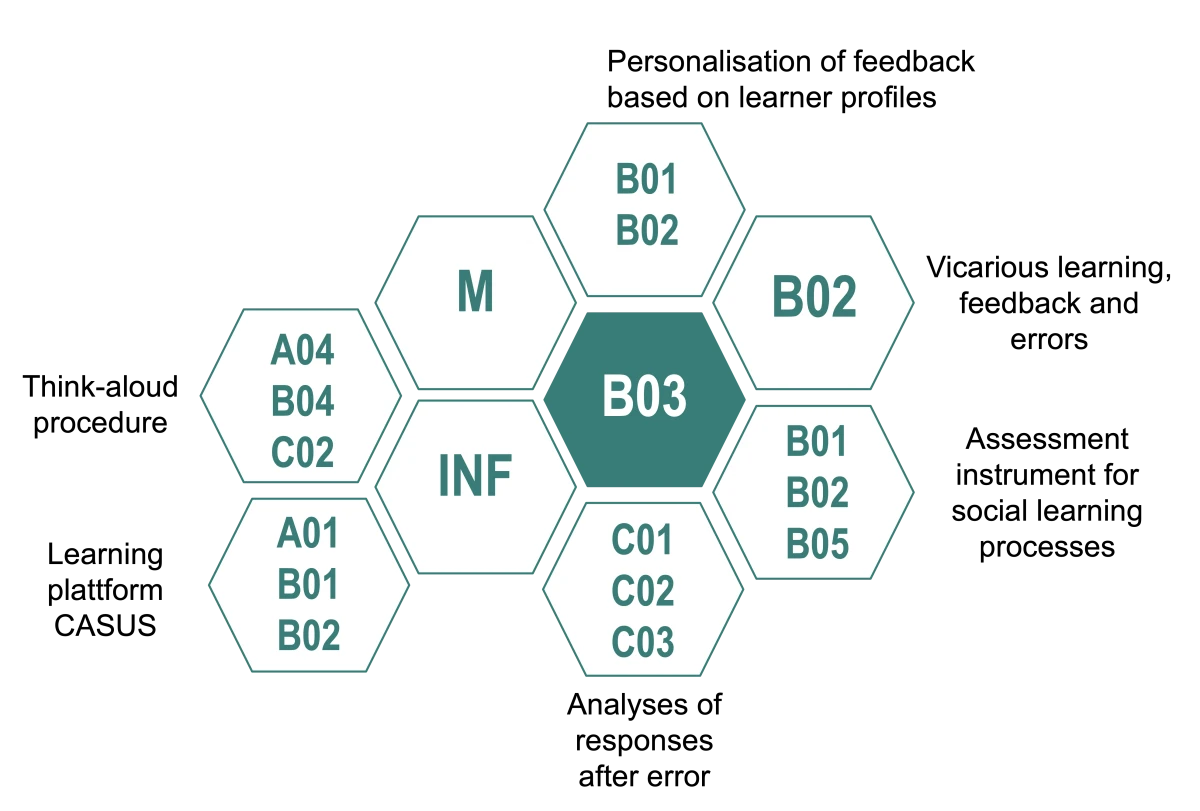
  • Joint data collection with Project M

  • Development of an automated process analysis with Project INF

  • B03, A03, and A06: Complex problem solving and its interaction with domain knowledge

  • B03 and A06: Interaction between case complexity, problem-solving behaviour, and prior knowledge

  • With A02: Clarification of the effects of task characteristics; investigation of the personalisation of task characteristics (representational scaffolding at the meso level)

  • B03 provides the conceptualisation of typicality for B01 and B02; joint definition and operationalisation of intervention skills

  • B03, A03, and B01 provide simulations to be used in B06

  • B03, B01, B02, C02, and C03: Consideration of the implementation of the second funding phase in the medical curriculum

  • B03, B01, and B02: Joint use of the CASUS learning platform

Publications

2023

2022

2021

2020

2019

2018

2017