Project A04

Project A04

Promoting diagnostic and intervention skills with simulations for programming & debugging: Effects of personalised representational and learning process scaffolding

Summary

A04 investigates the acquisition of diagnostic and intervention competencies among pre-service computer science teachers in the domain of programming and debugging through simulation-based learning. The project examines the effects of representational scaffolding that adapts the salience of cues. Furthermore, it investigates the effects of learning process scaffolding implemented through dashboards featuring metacognitive prompts. In addition, the effects of personalising these scaffolds are examined. The project comprises one validation study and three experiments to investigate these effects.


Participants

Principal Investigators

Research associates

Collaboration partners

Goal

The aim of A04 is to investigate the effects of personalised scaffolding on the acquisition of diagnostic and intervention competencies among pre-service computer science teachers through simulation-based learning in the domain of programming and debugging. In line with the SHARP framework, the project examines the effects of personalised representational scaffolding, which adapts the salience of relevant cues. Furthermore, the regulation of diagnostic processes is investigated. To this end, the effects of personalised learning process scaffolding implemented through dashboards featuring metacognitive prompts are analysed. The initial studies focus on the promotion and assessment of diagnostic competencies. In later studies, the development of intervention competencies is additionally examined.

Forschungsfragen

  • What effects do cue-salience scaffolds in simulations have on diagnostic activities and strategies, as well as on diagnostic quality, compared to a control condition?

  • Do cue-salience scaffolds in simulations lead to differential learning benefits depending on learners' characteristics?

  • What effects do process-data-based personalised cue-salience scaffolds in simulations have on diagnostic activities and strategies, as well as on diagnostic quality, compared to a non-personalised cue-salience scaffolding condition?

  • Do personalised cue-salience scaffolds in simulations lead to differential learning benefits depending on learners' characteristics?

  • What effects do personalised learning process scaffolds in the form of dashboards with adaptive metacognitive prompts in simulations have on diagnostic activities and strategies, as well as on diagnostic quality, compared to a non-personalised scaffolding condition and a control condition?

  • Do dashboards with personalised adaptive prompts in simulations lead to differential learning benefits depending on learners' characteristics?

Methodology

In Project A04, a video-based simulation of classroom situations involving students engaged in programming is first developed and validated. This simulation serves as the basis for three experimental studies investigating the relationships among prior knowledge, diagnostic activities, diagnostic quality, strategic diagnostic behaviour, and (personalised) representational and learning process scaffolding. To capture diagnostic processes, eye-tracking data, log data, and cued retrospective think-aloud protocols are collected. Based on the eye-movement, interaction, and think-aloud data obtained in the first experimental study, machine learning models are trained and subsequently used to personalise the scaffolding interventions in the following studies.

Role Within the Collaborative Research Center

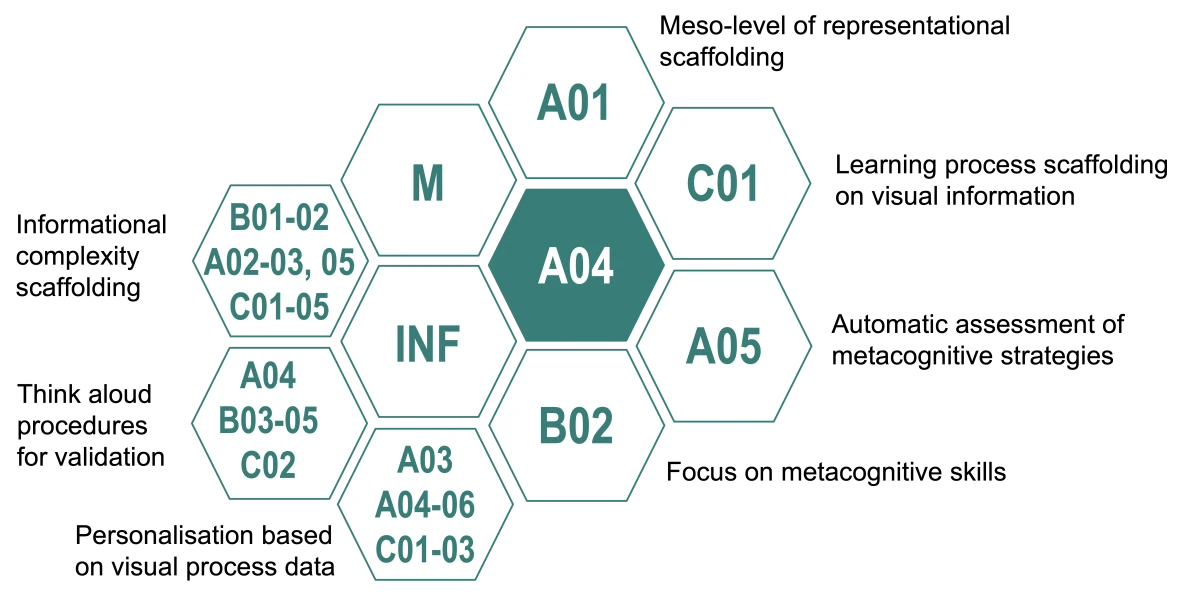
  • Joint data collection in collaboration with Project M.

  • Development of automated process analyses in collaboration with Project INF and Projects C01–C03, A03, and A06.

  • Collaboration with Project B02, focusing on metacognitive activities and self-regulation processes.

  • Collaboration with Projects B03, B04, and C04 on the use of think-aloud methods to validate behavioural indicators.

  • Joint development of a shared conceptual understanding of representational scaffolding through the salience of cues in collaboration with Projects A02, A03, A05, B01, B02, and C01–C05.

  • Collaboration with Projects C01–C03 on the use of eye-tracking data for personalisation decisions.

Publications

2026

2024

2023

2022

2021

2019

2014