Project C01

Project C01

Personalised support of advanced professional vision in teacher education through simulation-based training using eye movement modelling examples

Summary

C01 focuses on the personalised learning of visual processing strategies when diagnosing learning prerequisites in students as a basis for interventions in teaching. Diagnosing will be trained using EMT data as an adjustment base for personalised representational scaffolding through expert eye movement modelling examples (EMME). In a validation study, three experimental studies, and a post-hoc comparison, the project will investigate under which conditions visual processing strategies can be effectively fostered by EMME training for teachers and which additional advantages are offered by personalised learning process scaffolding and feedback.


Participants

Principal Investigators

Research associates

Collaboration partners

Goal

Project Project C01 investigates the effects of personalised simulations on the development of professional vision. It contributes to the understanding of how to support the processing of complex, dynamic information in simulations for higher education. The project combines eye movement modelling examples (EMMEs) as representational scaffolds with knowledge activation prompts as process scaffolds. It examines how individual learner prerequisites in professional vision determine the differential benefits of adaptive versus adaptable personalisation in EMME simulations.

Research Questions

  • RQ 1: Do experts in the field of teacher eye movement tracking research as well as pre-service teachers as users assess the designed simulation as relevant for representational scaffolding and as positive regarding user experience criteria?

  • RQ 2: Is an EMME simulation in which representational scaffolding is combined with learning process scaffolding (Intervention Condition / IC 2) more effective than previous approaches of solely using prompts (IC 1) as learning process scaffolding? Are both simulation variants more effective compared to a control group CG) without representational and learning process scaffolding?

  • RQ 3: Is adaptive personalisation in an EMME simulation additionally advantageous for promoting advanced professional vision and diagnostic and intervening skills? In our context, does the personalised provision of an overlay of individual participant gaze and expert modelling gaze (IC 3) provide an additional learning support compared to a non-personalised EMME simulation from Study 2 (IC 2)? Are both variants more effective than a CG?

  • RQ4: Is an adaptable personalisation in EMME simulations advantageous for promoting advanced professional vision and diagnosing/intervening skills? Specifically, does the ability for participants to self-regulate the use of gaze visualisations (personal gaze, overlay of personal and expert gaze) (IC 4) show positive effects compared to the non-personalised form of EMME simulation from Study 2 (IC 2)?

  • RQ5: Do the adaptive (IC 3) and adaptable (IC 4) personalisation in the EMME simulation result in differential benefits for learners with prerequisites of high and low advanced professional vision?

Methodology

The project uses EMME simulations embedded in an online platform, in which pre-service teachers work on noticing and reasoning tasks while observing authentic, staged classroom video clips with different forms of representational and process scaffolding. Methodologically, the project combines expert and user validation (Study 1) with experimental designs across four consecutive studies (Studies 2–5), using pre, process, and post measurements to examine the effects of non-personalised, adaptive, and adaptable EMME simulations. Data include advanced professional vision as a cognitive process measure, diagnostic and intervening skills as learning outcomes, and metacognitive and motivational-affective process variables, assessed through eye-tracking metrics, written open-ended responses, drag-and-drop matching tasks, and questionnaires. The analyses combine quantitative and qualitative approaches, including split-plot mixed ANOVAs, between-subjects ANOVAs for post-hoc comparisons, and qualitative coding of reasoning and intervention responses using established coding schemes.

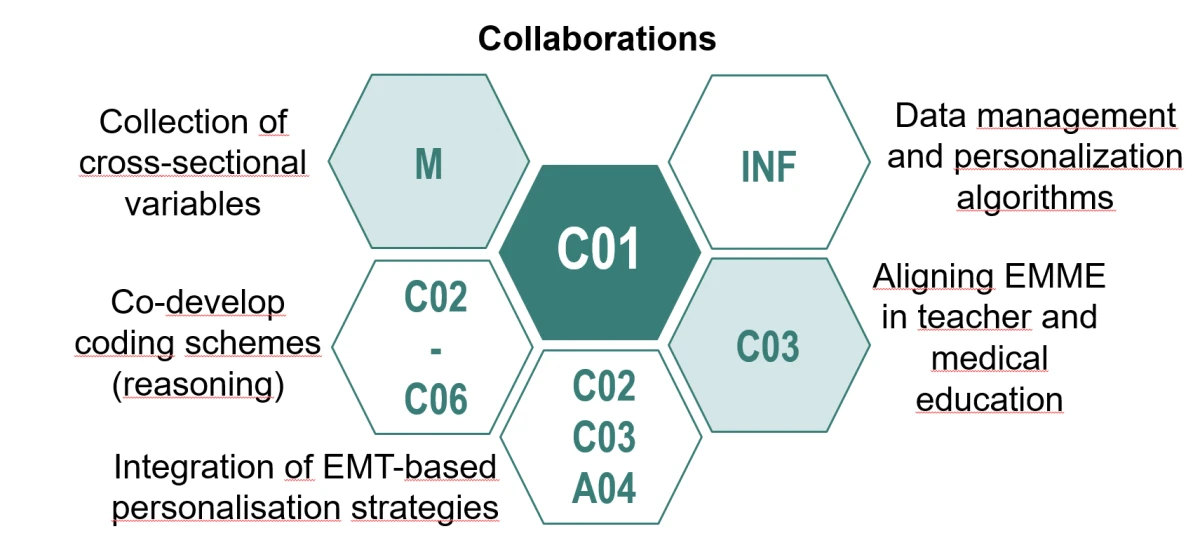
Role Within the Collaborative Research Center

  • Joint data collection with Project M

  • Comparable implementation of EMMEs with C03

  • Use of EMT as a basis for personalisation decisions with A04, C02, and C03

  • Co-development of coding schemes for qualitative reasoning data analyses with C02–C06

  • Personalisation based on visual process data with A03, A04, C02, and C03

  • Co-design of learning process scaffolds for complex visual processing with A04 and C03

  • Application of machine learning methods in EMT projects with C02, C03, INF, A03, A04, and A06

  • Research data management and personalisation of simulations based on EMT process data with Project INF

  • Joint development of the learning platform with C03

Publications

2024

2023

2022

2021

2020

2015

2014