Project C03

Project C03

Personalised support of medical students’ professional vision in ward round communication with focus on team coordination and empathy using eye movement modelling examples.

Summary

Project C03 examines how advanced professional vision (aPV) of medical students, as a key component of successful ward round communication, can be fostered through a personalised, digital, and simulation-based learning environment. The project focuses on eye movement modeling examples (EMMEs), which visualise the gaze behaviour of experienced physicians and serve as a basis for reflection. Based on EMMEs, learners analyse ward round communication and receive personalised feedback on their reflections using a large language model (LLM). The aim is the development and empirical evaluation of personalised simulations to foster aPV in medical students.


Participants

Principal Investigators

Research associates

Collaboration partners

Goal

The main objective of Project C03 is to improve learning and professional vision in medical students in the context of clinical ward rounds. The results aim to clarify differences between experts and novices and to identify the most effective types of EMMEs for the learning process. In addition, a personalised feedback system based on LLMs is developed and validated, and the contribution of different visualisations and knowledge activation prompts to the learning experience is examined. This leads to an improved learning environment for medical students.

Research Questions

  • RQ1.1: Can we identify expertise-specific differences regarding gaze patterns, regarding communication behaviours and regarding gaze-communication patterns which are specifically functional regarding the ward-round communication key tasks patient status assessment, clinical decision-making, and empathetic patient communication?

  • RQ1.2: Can we identify expertise-specific differences regarding the verbal reconstruction of novices vs. experts’ moment-to-moment decision-making during clinical ward round communication in cued-recall interviews?

  • RQ2: Is simulation-based learning of professional vision regarding clinical ward round communication more effective when combining EMMEs displaying raw fixations vs. displaying attention maps as representational scaffolds with learning process scaffolding?

  • RQ3: How does the design of LLM-generated feedback (textual vs. visual vs. combined) on learners’ written analyses of clinical ward round quality shown in EMMEs influence the content quality of their written analyses, their advanced professional vision from pre- to posttest, and their diagnosing/intervening skills from pre- to post-test?

  • RQ4: How useful are knowledge-activation prompts (a priori vs. embedded in EMMEs) regarding the content quality of learners’ written analyses, regarding their advanced professional vision between pre- and post-test, and regarding their diagnosing/intervening skills between pre- and post-test?

Methodology

The project uses digital, simulation-based learning environments in which medical students analyse ward rounds and work with EMMEs.

First, an experimental foundational study examines which gaze and communication patterns experts and novices show in simulated ward rounds. In particular, eye-tracking data as well as verbal data collected through think-alouds are obtained. These findings form the basis for the development of the learning environment.

Building on this, three experimental studies systematically investigate different instructional design features of the learning environment (gaze visualisation, feedback, prompts). A pre-test, post-test, and follow-up design is employed. Data include eye-tracking data, reflections, and learning process data collected through questionnaires, text analyses, and log data. Analyses are conducted using quantitative and qualitative methods.

Role Within the Collaborative Research Center

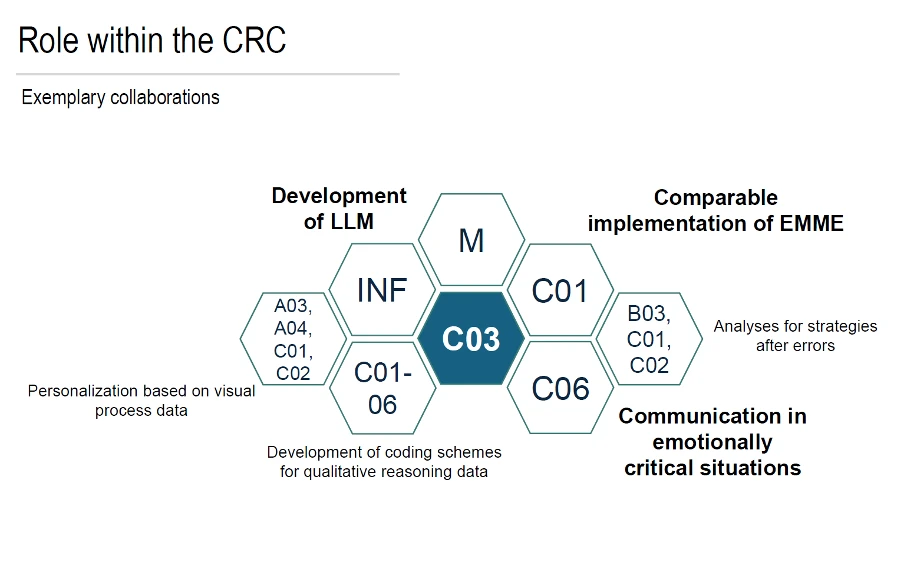
  • Collaboration with C01 to ensure a comparable implementation of Eye Movement Modeling Examples (EMMEs)

  • Cooperation with C06 (and C01–C05) on conceptualizing emotionally critical events and developing joint coding schemes for qualitative reasoning data

  • Application of machine learning methods in EMT projects under the guidance of INF (together with C01, C02, A03, A04, and A06)

  • Joint analysis of strategies following errors in conjunction with projects B03, C01, and C02

  • Contribution to the theoretical advancement of cue salience and informational complexity for representational scaffolding (with A02–A05, B01–B02, and all Area C projects)

  • Collaboration with Project M as well as A03–A05, C01, and C02 on personalization based on visual process data

  • Coordination with A04, C01, and C02 regarding the use of EMT as a basis for personalization decisions within study designs

  • Co-design of learning process scaffolds for complex visual processing demands together with C01 and A04

  • Support for B05 by providing data and material for a taxonomy of critical incidents and collaborating on personalized scaffolding strategies

  • Close cooperation with INF on research data management (RDM) and simulation personalization, and with M on joint data collection and aggregation

  • Exchange of relevant insights regarding expertise in ward round communication with Project B02

Publications

2024

2022

2021

2020

2019

2015

2014