Project C04

Project C04

Using personalised digital video simulations to facilitate pedagogical content knowledge in biology teacher education: Effects of learning process and representational scaffolding

Summary

C04 investigates how personalised support in video-based simulations improves the training of biology teachers. The focus is on the effectiveness of different adaptation approaches (learning prerequisites vs. learning processes), timeframes (macro vs. meso) and forms of support, such as learning process scaffolding and representational scaffolding, for the development of pedagogical content knowledge. The study is based on the DiKoBi simulation, which is enhanced using Natural Language Processing (NLP) to enable adaptive, process-based adjustments in real time. Three experimental studies investigate the effects on pre-service biology teachers at different stages of their training, with personal Pedagogical Content Knowledge (pPCK)  and enacted Pedagogical Content Knowledge (ePCK) being assessed via standardised tests and coded text responses. The results contribute to the substantiation of the Refined Consensus Model of Pedagogical Content Knowledge (PCK) and provide insights into transferability to different teaching situations and subject areas.


Participants

Principal Investigators

Research associates

Collaboration partners

Goal

C04 aims to investigate the effectiveness of personalised support in video-based simulations for the training of biology teachers by analysing different adaptation principles, timeframes and forms of support in terms of their effects on the development of pedagogical content knowledge. Using a simulation enhanced with natural language processing, the project aims to generate empirical findings that will contribute to the substantiation of the Refined Consensus Model of PCK and test its transferability to different teaching contexts.

Research Questions

  • Which adjustment base is more effective for fostering ePCK: learning prerequisites (pPCK) or learning processes (ePCK)?

  • Is meso-level adaptation more effective than macro-level adaptation for fostering ePCK?

  • How does representational scaffolding, compared to learning process scaffolding, affect the development of ePCK?

  • Does the learner’s level (beginner vs. advanced) influence the effectiveness of different scaffolding approaches?

Methodology

C04 combines experimental studies with the specific technical development of digital simulations, integrating both quantitative and qualitative data analysis. The basis is the DiKoBi simulation, enhanced by natural language processing, which enables adaptive, personalised learning support in real time. Data is collected at multiple measurement points (pre-test, intervention and post-test), with pPCK and ePCK assessed using standardised tests and coded text responses. In addition, cognitive load and situational interest are recorded as control variables to evaluate the effectiveness of the support.

Role Within the Collaborative Research Center

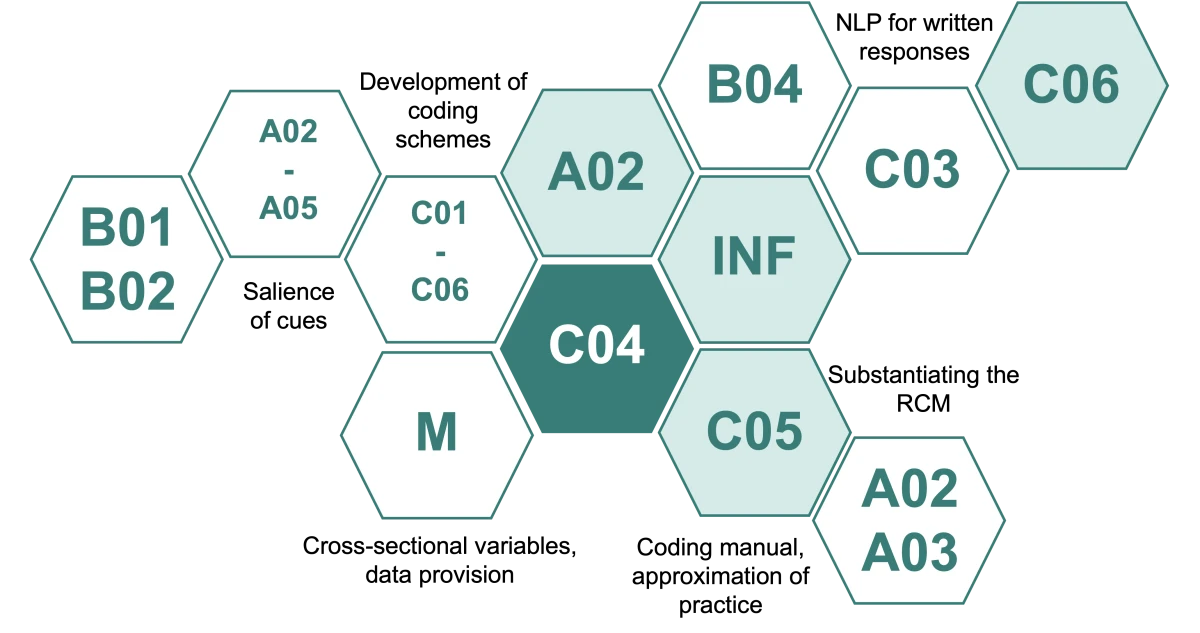
  • With C05: development of case studies for representational scaffolding in teacher education, including test materials, coding manuals, and background information on the creation of video-based simulations

  • C04, C05, C06: Approximation of Practice

  • A02, A03, C04, C05: substantiating the Refined Consensus Model of PCK

  • A02, B04, C03, C04, and INF: use of natural language processing to analyse written responses in learning environments

  • A01, A02, A04, A05, B01–B04, C01–C05: joint meta-analysis on the effects of learning process and representational scaffolding

  • A02–A05, B02, C01–C05: joint theory development on the topic of salience of cues

  • Joint data collection with Project M

Publications

2023

2022

2021

2020

2014