Project A01

Project A01

Promoting diagnostic and intervention skills in simulations through representational scaffolding: Effects of case typicality and case complexity

Summary

Project A01 investigates personalised simulations of medical patient cases. The cases are designed to represent disease patterns that vary in typicality and complexity, thereby providing a form of representational scaffolding. This adaptation of the simulations is based on learners’ individual prerequisites as well as their diagnostic and treatment activities within the simulation. The project focuses on identifying which learner characteristics and process-related indicators are particularly suitable for promoting diagnostic and intervention competencies through targeted adaptations of the simulation-based learning environment — both when learning with typical and atypical cases and with cases of varying complexity.


Participants

Principal Investigators

Research associates

Collaboration partners

Goal

The goal of A01 is to contribute to a deeper understanding of how representational scaffolding can support learning in simulations with personalised patient cases, particularly with regard to variations in case typicality and complexity. The project aims to investigate how different forms of case representation influence learners’ diagnostic and intervention processes and how these representations can be adapted to individual learner characteristics and learning activities. In doing so, A01 seeks to identify the conditions under which personalised simulations are especially effective in fostering diagnostic and intervention competencies in medical education

Research Questions

  • To what extent do clinical experts agree in their assessments of the typicality and complexity of medical cases — and how effectively can AI support these assessments?

  • What effects do typical compared to atypical patient cases have on diagnostic and intervention competencies?

  • Does a personalised adaptation of case typicality improve learning outcomes more effectively than a random sequence of cases?

  • Is adaptation after each individual case more effective than adaptation after several cases?

  • What role does learners’ prior knowledge play in the effectiveness of personalised simulations?

  • How does the complexity of patient cases influence the development of diagnostic and intervention competencies?

  • To what extent do cognitive learning processes explain the effects of personalised case typicality and case complexity on learning outcomes?

Methodology

Methodologically, project A01 combines validation, experimental, and mediation studies using simulation-based learning environments with virtual patient cases. The project examines diagnostic and intervention processes through pre-, process-, and post-measurements, including knowledge tests, questionnaires, written responses, and log-file data. Data analysis combines quantitative and process-oriented approaches, such as expert and AI-supported validation procedures, regression and mediation analyses, sequence analyses, and structural equation modelling.

Role Within the Collaborative Research Center

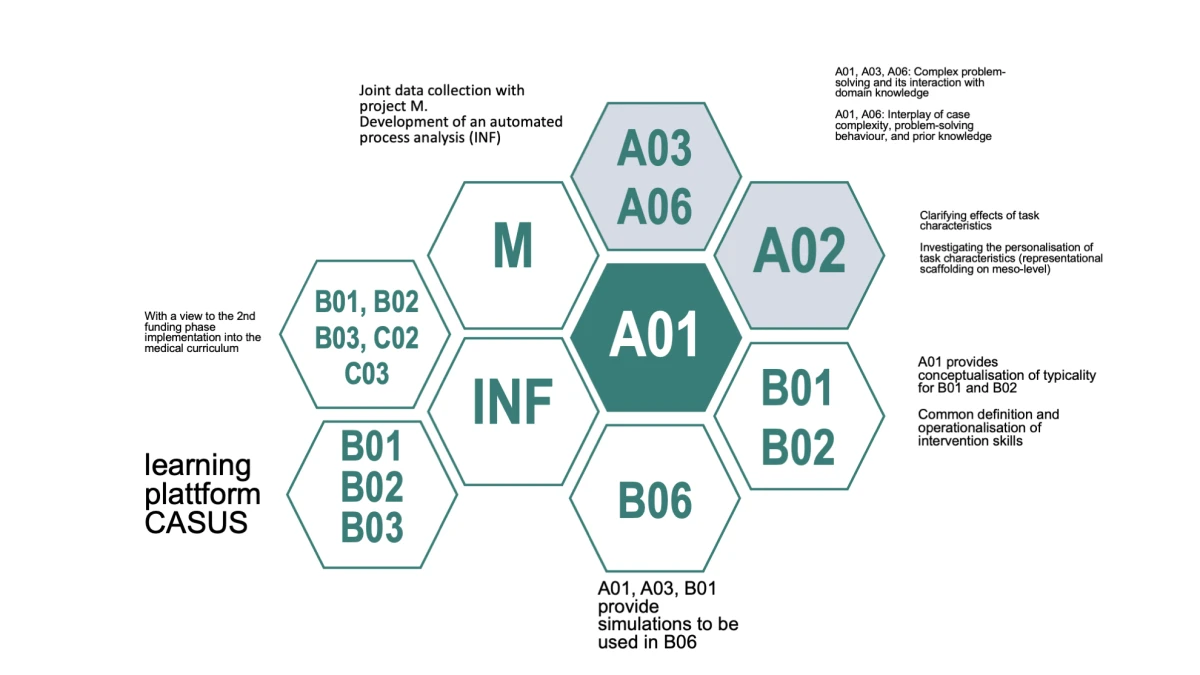
  • Joint data collection, data provision, and aggregation of process data with project M

  • Collaboration with project INF on research data management (RDM) and the personalisation of the simulation

  • Collaboration with A03 and A06 on complex problem-solving and its interaction with domain knowledge

  • Investigation of the interplay of case complexity, problem-solving behaviour, and prior knowledge together with A06

  • Clarification of the effects of task characteristics and the personalisation of task characteristics (representational scaffolding) on the meso level together with A02

  • Implementation of simulations using the learning platform CASUS together with B01, B02, and B03

  • Conceptualisation, definition, and operationalisation of intervention activities and intervention skills together with B01 and B02

  • Contribution to A01’s conceptualisation of case typicality for the selection and adaptation of practice representations in B01 and B02

  • Provision of simulations by A01, A03, and B01 for use in project B06

  • Future implementation (second funding phase) of the simulations into the medical curriculum via the learning platform CASUS together with B01, B02, B03, C02 and C03.

Publications

2024

2023

2022

2021

2020

2019