Project A02

Project A02

Personalised support for the development of  diagnostic  and intervention skills during mathematical learning tasks: Case characteristics, cueing and knowledge activation

Summary

Project A02 investigates how case characteristics and different forms of instructional support in simulations influence the development of diagnostic and intervention competence in pre-service mathematics teacher education. We systematically vary two case characteristics: the typicality of cases and the salience of diagnostic information. We examine cues to relevant diagnostic information and prompts for knowledge activation as two forms of instructional support.  These variations enable a comparison of different personalisation strategies regarding their contribution to fostering diagnostic and intervention competence. In this project, Knowledge activation is conceptualized as a central learning process. The overall aim is to understand how personalized simulations can support the development of professional competences.

Participants

Principal Investigators

Research associates

Collaboration partners

Goal

The aim of Project A02 is to provide empirical evidence on how adapting case characteristics and instructional support facilitates the activation and application of professional knowledge in simulations. It examines how personal, case-related, and instructional determinants interact to influence knowledge activation and pre-service mathematics teachers’ diagnostic and intervention skills. Thus, the project compares different personalisation strategies regarding their contribution to fostering diagnostic and intervention competence. The project aims to provide evidence-based approaches for the design of personalized, simulation-based learning environments.

Research Questions

  • How can pre-service mathematics teachers’ knowledge activation be assessed in real time based on log file data, and to what extent does it predict learners’ performance in the simulation?

  • What are the (joint) effects of representational scaffolding (salience, typicality) and learning-process scaffolding through cueing and knowledge-activation prompts on cognitive learning processes (knowledge activation), diagnostic and intervention-related processes, and case-related outcomes?

  • How do learning prerequisites and knowledge activation observed in previous cases moderate the effects of representational scaffolding and learning process scaffolding?

  • Which personalisation strategies for representational scaffolding and learning process scaffolding contribute most effectively to the development of diagnostic and intervention skills?

Methodology

Project A02 uses simulation-based learning environments in mathematics teacher education in which learners work on diagnostic and intervention tasks across different cases that vary systematically with regard to case characteristics and the type of support provided. The simulations focus on supporting students during mathematical learning tasks on fractions. Methodologically, the project includes the automated coding of knowledge activation in open-text responses using NLP approaches and machine learning models, experimental designs with pre-, process-, and post-measures to examine the effects of representational and learning-process scaffolding, as well as intervention studies with pre-, process-, and post-measures to compare different personalisation strategies. The collected data include learners’ prerequisites, knowledge activation, diagnostic and intervention-related processes and skills, as well as metacognitive and motivational-affective aspects, assessed through open-text responses, questionnaires, knowledge tests, and log data. Data analysis primarily relies on quantitative methods, particularly linear mixed models, to examine main and interaction effects.

Role Within the Collaborative Research Center

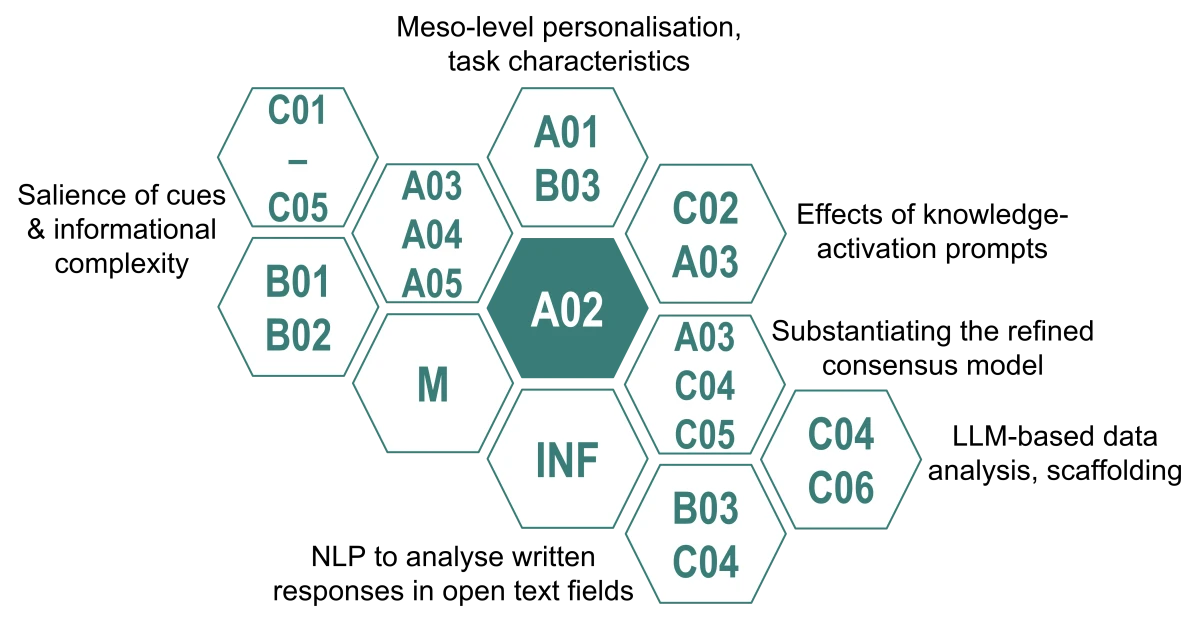
  • Data collection for joint measures with Project M

  • With A01 and B03: Clarifying the effects of task characteristics; investigating the personalisation of task characteristics (representational scaffolding on the meso-level)

  • With A03–A05, B01, B02 and C01–C05: Joint theory development on the salience of cues (representational scaffolding)

  • With B04 and C03, guided by INF: Use of NLP to analyse written responses in open text fields

  • With C04 and C06: Collaboration on LLM-based data analysis and scaffolding

  • With A03, C04 and C05: Substantiating the Refined Consensus Model of Pedagogical Content Knowledge (RCM); investigating the conditions under which learners transform their personal pedagogical content knowledge (pPCK) into enacted pedagogical content knowledge (ePCK) in simulation-based learning environments

  • With C02 and A03: Conceptual work on diagnostic and intervention skills in mathematics and physics; exploring the effectiveness of knowledge-activation prompts

Publications

2024

2023

2022

2021

2018