Project B04

Project B04

Symptoms of learning and behavioural difficulties: Enhancing the diagnostic and intervention-related skills with adaptive feedback 

Summary

Project B04 investigates the conditions under which feedback in simulations can support students with varying professional specialisations in diagnosing and addressing learning and behavioural difficulties in children. Large Language Models (LLMs) will be employed to adapt feedback to individual differences among learners. In two validation studies, a think-aloud and two experimental studies, the project analyses the effects of different forms of feedback (static/macro-adaptive/micro-adaptive) on learning processes, as well as on diagnostic and intervention-related skills.


Participants

Principal Investigators

Research associates

Collaboration partners

Goal

Project B04 investigates how different forms of feedback (static/macro-adaptive/micro-adaptive) can foster university students’ diagnostic and intervention-related skills when working with digital case simulations of pupils with learning and behavioural difficulties. Across disciplines such as medicine, teacher education, and school psychology, the project examines how prior knowledge and adaptive support influence learning processes and diagnosing in authentic simulation-based contexts.

Research Questions

  • How do students from medicine, teacher education, and school psychology differ in their prior content, diagnostic, and intervention-related knowledge regarding learning and behavioural difficulties?

  • How do different types of feedback (static/macro-adaptive/micro-adaptive) influence learners’ diagnostic and intervention-related skills in digital case simulations?

  • How does prior knowledge affect cognitive, metacognitive, and motivational learning processes during case-based learning?

  • Which forms of adaptive feedback are most effective for learners with different levels of prior knowledge?

  • How do adaptive feedback systems support learners’ diagnostic and intervention-related reasoning?

  • How can think-aloud data and trace data be used to better understand learning processes in simulation-based environments?

Methodology

Project B04 uses simulation-based learning environments in medical, school psychology and teacher education, in which learners work on diagnostic tasks and receive different types of feedback. Methodologically, the project combines experimental designs with pre-, process-, and post-measurements to examine the effects of the type of feedback on diagnostic and intervention-related skills. Data include measurement of diagnostic and intervention-related skills, learner prerequisites, cognitive, metacognitive, and motivational-affective processes, assessed through open questions, questionnaires, knowledge tests, aswell as think-aloud- and logdata. The analyses combine quantitative and qualitative approaches, including analyses of variance, correlations, sequence analyses, and learner profile modelling. 

Role Within the Collaborative Research Center

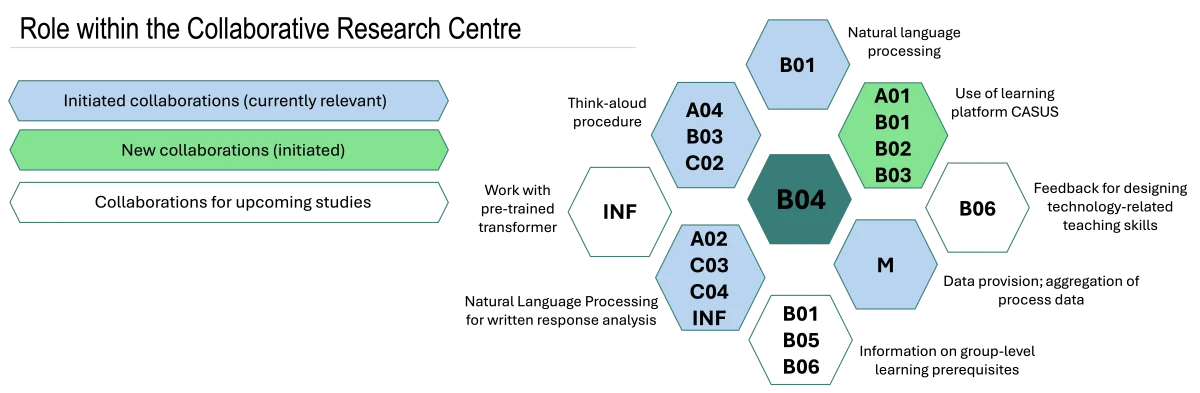
  • Joint data collection with Project M

  • Development of an automated approach for process analysis with Project INF

  • B04 and B01: Implementation of AI Feedback in digital learning environments

  • B04 and A04, B03, C02: Using Think-Aloud methods for exploring learning processes

  • B04 and A02, C03, C04, INF: Natural Language Processing (NLP) for written response analysis

  • B04 and B01, B05, B06: Information on group-level learning prerequisites

  • B04 and B06: Feedback for designing technology-related teaching skills

  • B04 and A01, B01, B02, B03: Joint use of the CASUS learning platform for simulations

Publications

2025

2024

2023

2022

2020

2014