Summary
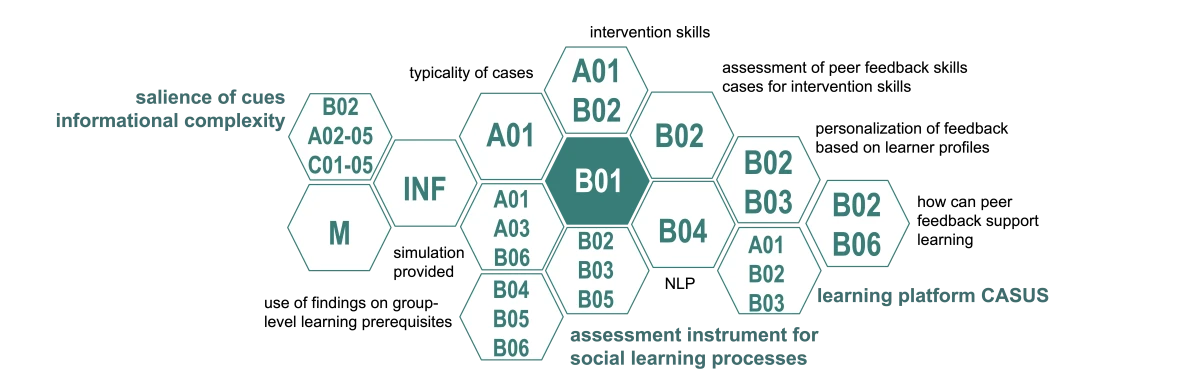
Project B01 examines the conditions for effective peer-feedback in the context of simulation-based learning in medical education. Central to the project is the question of under which conditions providing peer-feedback promotes diagnostic and intervention skills in simulation-based learning environments. Across four studies, the project investigates effects of representational scaffolding on cognitive, meta-cognitive and social learning processes, as well as on diagnostic, intervention, and professional peer-feedback skills. Representational scaffolding aims to use machine learning algorithms to adaptively match learners with simulated peer-performance that varies in the salience of cues, based on the learners' learning needs and prior performance. The project thereby contributes to theory-building on peer-feedback provision and on adaptive representational scaffolding in simulation-based learning environments.