Project B06

Project B06

Curricular opportunities and university teachers’ skills to use adaptive simulation environments to support individuals and small learner groups

Summary

Project B06 examines how personalised simulation environments can be integrated into higher education. Two prerequisites are central. The first is how simulation-based teaching can be integrated into curricula. The second is the skills university teachers need to support learners. The project combines four interconnected studies in medical and teacher education. Studies 1 and 2 use document analyses, expert interviews, and classroom observations to map curricular opportunities and skill demands. Study 3 surveys university teachers across Germany to assess their qualification needs. Building on these findings, Study 4 develops a tailored training programme and tests its effects in a randomised controlled study. The results help teachers support social interaction, collaboration, and feedback in simulation-based learning environments.

Participants

Principal Investigators

Research associates

Collaboration partners

Goal

Project B06 examines how universities can successfully embed personalised, simulation-based learning environments into their curricula. It analyses the curricular conditions and the specific skills university teachers need to support learners and small groups in personalised learning environments. Building on these findings, the project develops and tests a training programme that strengthens these skills, with a particular focus on guiding social interaction, collaboration, and feedback.

Research Questions

  • What possibilities do study programmes in medical and teacher education offer for simulation-based learning?

  • Which curricular and organisational conditions enable or hinder simulation-based teaching?

  • Which basic technology-related teaching skills are particularly relevant in simulation-based higher education?

  • What specific skills are required for teachers to support learners in highly personalised learning environments embedded in social interaction and social contexts?

  • How can these skills, including abilities to support social interaction and collaboration and to provide feedback, be promoted?

  • To what extent do university teachers possess these skills?

  • What effects does a targeted training programme have on the knowledge and skills of university teachers?

Methodology

DaThe project uses a mixed-methods design with four studies that build on each other. Document analyses and expert interviews map curricular opportunities for simulation-based teaching. Participant observations of seminars, video analyses, and tandem interviews identify the specific skills teachers need. A nationwide online survey combined with a Situational Judgement Test measures these skills, and a randomised controlled training study evaluates the effects of a tailored professional development programme.

Role Within the Collaborative Research Center

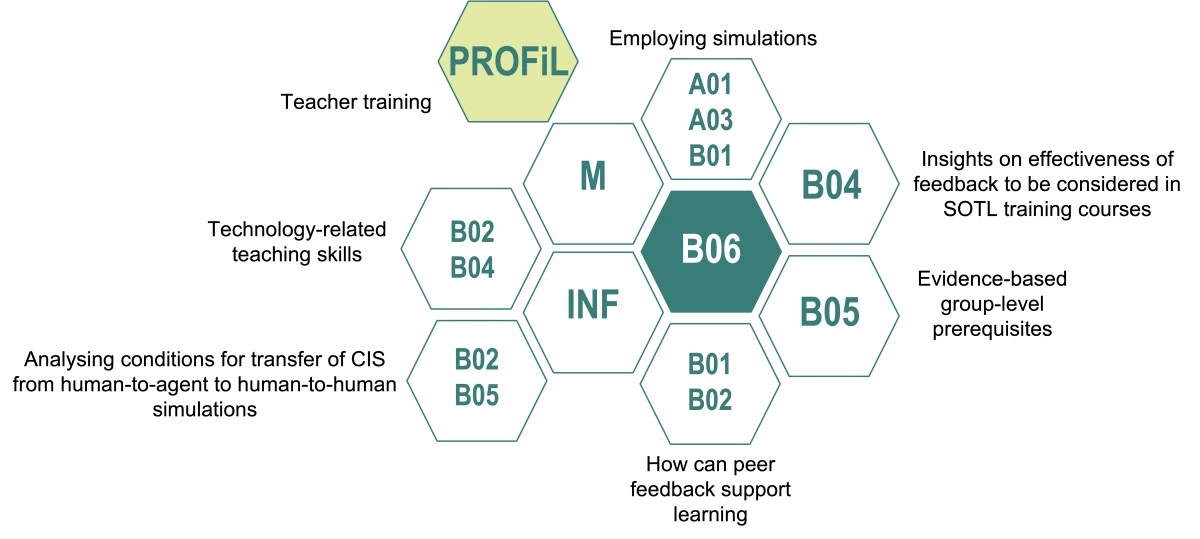
  • With Project M: joint data collection of cross-sectional variables and meta-analytical findings on the curricular embedding of simulations

  • With Project INF: research data management

  • With A01, A03, and B01: use of their simulations in higher education courses

  • With B01 and B02: peer feedback as a means to support learning

  • With B02, B04: technology-related teaching skills

  • With B02 and B05: enabling conditions for transferring collaborative intervention skills from human-to-agent to human-to-human simulations

  • With B04: insights on the effectiveness of different feedback types for the Scholarship of Teaching and Learning (SOTL) training programme

  • With B05: building on the identified group-level learning prerequisites

  • With PROFiL at LMU: teacher training and development of a training programme on simulation-based teaching for higher education teachers

Publications

2024

2022

2021

2020

2019

2018